
Wondering if there is a specific time on specific days during which you should stream? And if there is a magic number of hours you should target while you’re streaming?
You’ve come to the right place!
There is no written rule or guideline on the best time to stream on Twitch. But I’ve compiled data from multiple forums and websites like Twitch Tools, Twitch Tracker, Reddit, and Quora to give you a definitive guide on the Best Time to Stream on Twitch.
In this guide, I will try to answer the most frequently asked questions about when and for how long you should stream:
Let’s get started.
What are the Best Times and Best Days to Stream on Twitch?
With regards to finding the maximum viewers on Twitch. The best time to stream on Twitch is Friday, Saturday and Sunday between 12 PM – 5 PM PST. This is also the time when you will find the maximum competition as well.
So, if you are a beginner on Twitch and trying to stream at these intervals, it might not work out for you. The best time for a beginner to stream on Twitch is on Monday and Tuesday between 12AM – 5AM PST, this is when you will find the least competition and an audience with less expectations.
It can get highly competitive during the peak intervals, so the best way to choose your stream timings is by being smart and analyzing your audience.
You will find an audience on Twitch 24×7. Because of the different time zones, there are people logging in at all intervals. You will have to consider the below factors when deciding on the best time to stream on Twitch.
- Game being played
- Target Audience
- Target Location
- Competition
You can use the checks below to arrive at your own best time to stream on Twitch, including the best days and best time to Livestream.
Finding the Best Time to Stream on Twitch
The best time to stream on Twitch should be based on the ratio of “viewership per streamer” most suitable to your channel stage. i.e. Beginner, Seasoned, or Pro.
Everybody knows, how difficult it is for a small streamer to get views on Twitch. Twitch sorts streamers from largest to smallest viewers by default. Hence for a small streamer, it is harder to be found if there are more streamers.
Finding the ratio of “viewership per streamer” will help you gauge your competition and enable you to be more discoverable. This ratio can vary from one game to another, check for all relevant games that you wish to stream.
You can find the ratio of “viewership per streamer” from analytical sites like Twitchtracker.com.
How to get data to find the best time to stream on Twitch?
- Go to TwitchTracker.com, it is a Twitch analytics website where you can find the concurrent viewers’ and streamers’ information for any game
- Enter the game that you want to stream. The ratio can vary from one game to another, so you can repeat the steps and get data for all the games to analyze. I have taken “Dead by Daylight” as an example here

- Go to the channel page, you will see all the live viewer and streamer information

- Scroll below to get the graph representing average number of viewers and streamers for the week
- Make sure to tick “7 DAYS” and “Average” on the options present at the top of the graph

Now let’s try to understand how to interpret this graph and find the best time to stream on Twitch for Dead by Daylight.
Analyzing data based on your channel stage to find the best time to stream on Twitch
According to Twitch tracker’s weekly concurrent channels and viewers graph, we can generally see the pattern for the avg. footfall and the concurrent channels throughout the day. Through this pattern, we can arrive at the following 3 segments of time slots that you can consider for your stream.

Source: Twitchtracker
- Twitch peak times – Best time to stream for Seasoned Streamers
More streamers, more viewers, with the best viewership per streamer (4 PM – 9 PM UTC)
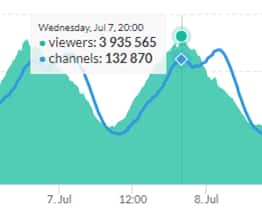
Source: Twitchtracker
Twitch viewer count usually starts to climb substantially after 4 PM UTC and hits a peak between 6 PM to 9 PM UTC at an average of 3 million to 3.5 million viewers.
This is the time when adults find time to relax after work and kids after school. This is also when you would find the maximum streamers streaming for those viewers’ attention as well.
From 4 PM till 9 PM UTC, there are more viewers per average channel than any other time slot. This is the best time to stream for seasoned streamers to be accessible to a larger pool of audience.
- Twitch time with less competition – Best time to stream for beginners
Less streamers, less viewers, but decent viewership per streamer (10 AM – 4 PM UTC)

Source: Twitchtracker
You will find the lowest number of streamers on Twitch from 7 AM to 9 AM UTC. The number of viewers starts increasing from 12 PM UTC onwards.
From 10 AM till 4 PM UTC can be a good time for new streamers to stream. There might be relatively less popular streamers to compete with. There is also potential to gain followers from early viewers on Twitch. This time slot also has more viewers per streamer, compared to the time slot 12 AM to 7 AM.
If you are targeting morning time, it’s best to pick the right content type like podcasting or the “Just Chatting” section on Twitch. This way your viewers can listen to you in case they are not paying attention.
- Twitch time with more competition – Best time for professionals
More streamers, less viewers, with less viewership per streamer (12 AM – 7 AM UTC)

Source: TwitchTracker
According to the graph from Twitchtracker, from 12 AM to 7 AM UTC the viewership starts to drop, but the number of streamers remains quite high till 3 AM to 4 AM.
This usually happens as a lot of streamers stream till late for long hours. Also, popular streamers stream during the peak hours till late to get a good number of viewers to their stream. The viewers on the other hand start to taper off and go down considerably after 3 am.
12 AM onwards till morning is suitable for hardcore streamers who have a loyal fanbase.
RELATED:
Finding the Best Days to Stream on Twitch
The best days to stream on Twitch should be based on “Higher viewership per channel” ratio. You can use tools like TwitchTracker and TwitchTools to find out which games have a higher viewership per channel ratio. These are the games with a high viewership count and low competition.
How to get data to find the best days to stream on Twitch?
Let’s take a particular game and try to analyze it for the good times to stream on Twitch. Below are some statistics for “Dead by Daylight” taken from TwitchTracker.
- Like earlier visit Twitchtracker.com and search for the game you want to stream
- Scroll below on the game page to find the “Days of the week analysis“, this will tell you how many viewers and channels in average were present on each day of the week
- No need to change any settings, it will show you the average of the last 6 months
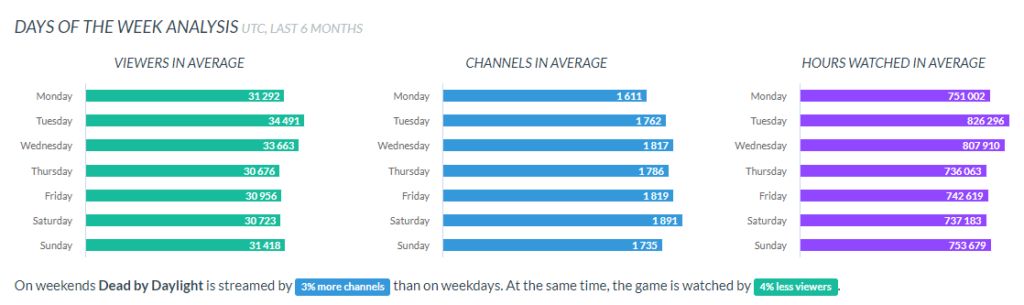
Source: Twitchtracker
Analyzing data to find the best days to stream on Twitch
- Analyze the best days of the week to stream your game
If you look at the data for the Twitch stream on 7 different days, you can calculate on which days there is less competition.
| Day | Avg. viewers per channel | Ratio |
| Monday | 31,292 / 1611 | 19.42 |
| Tuesday | 34,491 / 1762 | 19.57 |
| Wednesday | 33,663 / 1817 | 18.52 |
| Thursday | 30,676 / 1786 | 17.17 |
| Friday | 30,956 / 1819 | 17.01 |
| Saturday | 30,723 / 1891 | 16.24 |
| Sunday | 31,418 / 1735 | 18.10 |
After calculating the average, you can see that on Tuesday the ratio was the highest, which means there are more viewers available per stream on Tuesday than on the rest of the days.
You can then rank your days to find more reach and less competition during your Twitch stream times.
According to the calculations, for the game “Dead by Daylight”, the best days to stream on Twitch would be Tuesday and the worst is Saturday.

- Stream when your target audience is watching
Another good strategy is to think about when your target audience size would have the highest viewership on Twitch. If your target audience is students, then probably the best time to Twitch stream is during the evenings and nights when the students are relatively free from their school or college. You can also stream more regularly during their summer breaks or near the holidays.
The example from before, for “Dead by Daylight”, a multiplayer horror game, the best hours to stream on Twitch is at night from 12:00 AM onwards as it is for the horror genre audience. It also coincides with the time frame when viewership is high (and competition is low).
This strategy therefore can also help you choose your game, see what your target audience is interested in and start playing that game more often.
RELATED:
How Long Should You Stream on Twitch per Session?
On average, a full-time Twitch streamer streams for about 3-4 hours per day.
Logging in at least 3 days a week is good practice for maintaining familiarity with your audience. The longer you stream, the more chances are there to grow. However, stream content and quality play a major role in that growth as well.
Less than 2 Twitch stream hours is usually not recommended when you are starting out. Only the most professional and established streamers can get away with fewer streaming hours as they can still manage to pull that viewership. But for beginners or streamers on the grind, you need to put in that effort to jump-start your career.
Finding viewers is the key to success on Twitch, in the beginning, there won’t be any streamers willing to stick to your channel unless it’s of great quality.
To make yourself visible among the large number of streamers that exist, you will have to stream for at least 3-4 hours every day.
This might be beneficial to see some viewers trickling in the duration of the stream based on your content type.
It is also essential to keep a watch on who joins your stream. Ensure to keep them engaged and try to ask them questions about themselves or their interest in the topic. This can help you retain that viewer for a longer duration and also might tempt her or him to check your stream out in the subsequent days.
You can put up a streaming schedule to let your viewers know when you stream.
How Often Should You Stream on Twitch?
Generally the more often you stream, the more chances for you to grow on Twitch. A smart streamer knows that streaming is just 50% of the work. The rest of the 50% time is spent on building your brand.
The best way to do this would be to stream on alternate days, for a minimum of 3 days a week, and use the rest of the days to manage all other brand and content creation-related stuff.
Creating your streaming brand and content may include:
- Creating interesting content on other platforms to increase reach
- Upgrading your setup
- Designing your streaming panels
- Creating your brand logo and other unique brand elements like emotes
- Finding unique and interesting soundtracks
- Working on your personality
- Researching and analyzing your growth strategy
These are all important factors to consider while streaming. Small steps can give you a massive following if you do them the right way.
You need to find time at the beginning of your former years more than in the later years to establish your brand.
If you can manage to do all the above and still have time left in the day, then you should aim to stream at least 5 days a week for faster growth. But, only if you can manage all of the above while streaming. If you concentrate only on Streaming and do it all days of the week, it might not be as beneficial as you think.
Should You Stream Multiple Times a Day?
If you are streaming for more than 3 hours, it is advisable to break your stream into two or more batches of 3 hours each to increase your reach.
Breaking your stream across multiple batches has many advantages. Below are some of them:
- Target multiple locations based on your target audience:
You can reach multiple locations (US, UK, or wherever your target audience is). Find out the good times to stream on Twitch for your particular game and then try to stream at that time. Based on a viewer’s perspective, usually, the average viewership is more post 7 PM local time.
You can make use of the time difference between the locations that you are targeting. For example, London and Newyork are 5 hours apart. Hence if you are targeting viewers from both locations, I would suggest keeping the same time difference of 5 hours between both your streams. You can then target viewers from both locations during the same time of their day.
In this way, you are also targeting the best time to Twitch stream your particular game in both locations.
- Experiment with time slot:
In the beginning, you can experiment by streaming in multiple batches to figure out the best-suited time for your audience for that game. Keep a distinct time interval between each stream to arrive at the best hours to stream on Twitch.
- Take rest, take care:
Streaming is more like a marathon, not a sprint. If you stream for longer hours, you may lose out on the quality of the stream and viewers’ attention. This usually happens on a longer stream when the streamer runs out of energy. Streaming in batches will give you the creative headspace to keep your live stream fresh.
Remember, if you are streaming for longer hours (6-7 hours), you need to keep your energy levels high throughout. For some streamers, it comes naturally as it depends on your habits as well. Keep hydrated and take a pause once in a while between your streams. So much screen time would take a toll on your health in the long run, if you don’t take care of yourself.
In Conclusion
Streaming longer hours may not be the ultimate recipe to success, you have to be smart in choosing the right games, time slots, time zones, and days to reach your target audience while streaming.
It does not matter if you are a beginner or a popular streamer, you need to have a streaming schedule that you mostly adhere to. Popping up randomly or streaming at odd times may confuse your audience leaving you with less growth.

2 thoughts on “Best Time to Stream on Twitch: A Definitive Guide”
Comments are closed.